Three Signatures to Swap: What EIP-7702 Fixed, and What EIP-8141 Promises
Reading time: 11 minutesOn 16 November 2026, Sebastian Bürgel, VP of Technology at Gnosis, posted this:
We may be poor
We may not have any users left
We may not have products that anyone wants to useBut about a decade of intellectual masturbation did win us the technical beauty award for swapping tokens on a useless L2 with now 3 (THREE) signatures: approve, permit2, swap to then bridge it over to where we want to be (ideally again with 3 signatures).
But have we earned it?
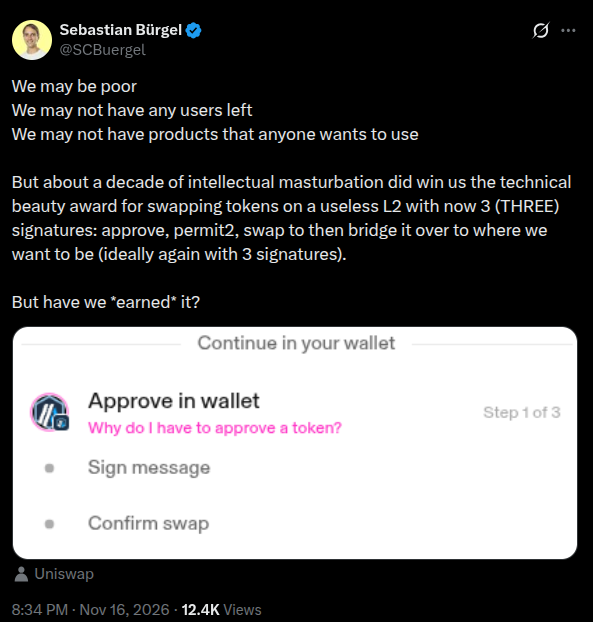
The screenshot under his post says it all: Step 1 of 3. Approve in wallet. Sign message. Confirm swap. And right under the first step, the app has to add a link that asks, “Why do I have to approve a token?”
It is funny because it is true. It is also a good excuse to ask a serious question: what did EIP-7702 actually fix, what is EIP-8141 promising on top of it, and is the protocol even the right place to solve this?
Grab a cup of water. Let’s go through it.
Why one swap needs three signatures
The root of the problem is older than any of these EIPs. It is the ERC-20 approval model.
An ERC-20 token cannot be “pushed” into a smart contract as part of a call. Instead, you first give the contract permission to move your tokens (approve), and then the contract pulls them (transferFrom) when it does the swap. That is two separate transactions, each with its own signature and its own gas fee.
The industry then tried to make this better, and each fix added a step of its own:
- EIP-2612 permits let you approve with an off-chain signature instead of a transaction. But only tokens that implement it support it, and many of the most used tokens do not.
- Permit2, from Uniswap, works for any token. You approve the Permit2 contract once per token, and after that each app gets a signed, time-limited permission instead of a new on-chain approval.
That is exactly the three steps in Sebastian’s screenshot:
- Approve in wallet: a transaction that lets Permit2 spend the token.
- Sign message: a Permit2 signature for this app and this amount.
- Confirm swap: the swap transaction itself.
Then the tokens are on the wrong chain, so you open a bridge and repeat a similar dance. Each step is a moment where the user is asked to sign something they mostly cannot read, on a screen that mostly cannot explain it. With a digital signature, the user does not really “see” what they sign; they trust the interface to describe it honestly.
How EIP-7702 works
This section draws on Eco’s ERC-7702 deep dive, which is worth reading in full.
EIP-7702 was written by Vitalik Buterin, Sam Wilson, Ansgar Dietrichs and Matt Garnett, and went live on Ethereum mainnet on 7 May 2025 with the Pectra upgrade. It replaced an earlier proposal, EIP-3074, which tried to reach the same goal with a new AUTH opcode and “invoker” contracts.
The idea is simple to say: a normal account (an EOA) can borrow the code of a smart contract, without changing its address.
Delegation, not deployment
7702 adds a new transaction type, 0x04, called SetCode. On top of the usual fields, it carries an authorization_list. Each entry is signed by the EOA that wants to upgrade and contains:
(chain_id, address, nonce, y_parity, r, s)When the transaction runs, the EVM checks each authorization. If the chain ID and nonce match, it writes a small delegation indicator into the EOA’s code field: the prefix 0xef0100 followed by the 20-byte address of the implementation contract. From then on, any call to the EOA runs that contract’s code, as if it were the EOA’s own.
No bytecode is copied, nothing is deployed and no funds move. The address that has your history, your ENS name, your NFTs and your reputation stays exactly the same.
A few details matter a lot in practice:
- Chain ID. An authorization with a specific chain ID only works on that chain. An authorization with
chain_id = 0works on every chain that supports 7702. That is convenient (one signature for mainnet and all L2s), but it is also a replay risk if the user does not understand what they signed. - Revoking. To undo a delegation, you sign a new authorization pointing to the zero address. One transaction, no timelock, no admin.
- Storage. The implementation reads and writes the EOA’s own storage, the same way a
delegatecallproxy does. A badly written implementation can corrupt that storage, and two implementations that use the same storage slots can overwrite each other if you switch between them. - Cost. Each authorization costs 25,000 gas, with part of that refunded if the account already exists. Usually that is paid once, when the delegation is first set.
7702 and ERC-4337 work together
7702 does not replace ERC-4337. ERC-4337 gives smart accounts their machinery: user operations, bundlers, the EntryPoint contract and paymasters that can pay gas for the user. Its weakness was that a 4337 account lives at a new address, with no history attached.
7702 answers only the address question. An EOA can delegate to a 4337-compatible implementation (from Safe, Coinbase Smart Wallet, MetaMask Smart Account and others) and then use bundlers and paymasters like any smart account, while keeping its original address. In practice, wallets ship both: a 4337 path for brand-new smart wallets, and a 7702 path for people upgrading an existing EOA.
What it unlocks
Once an EOA delegates to the right implementation, it gets the features smart wallets have had for years:
- Batched transactions. Approve, swap and deposit in one atomic transaction. If any step reverts, everything reverts.
- Gas sponsorship. A paymaster can pay the gas, so the user can pay in USDC, in app credits or not at all.
- Session keys. A limited key, for example “this game contract only, at most 0.05 ETH, for two hours”, so the user signs once instead of every move.
- Spending limits, allowlists and recovery. Rules and guardians live in the implementation, while the EOA’s signature still authorizes each transaction.
The risks it brings
- Malicious delegations. The implementation controls the account. A phishing site that gets you to sign one SetCode authorization for an attacker’s contract can drain the account on the next transaction. Wallets have to show the delegation target clearly and warn on unknown contracts. Trust Wallet, for example, shows the verified name of the target when it can and a clear warning when it cannot.
- Chain-zero replay. A
chain_id = 0authorization signed “for mainnet” is valid everywhere 7702 runs. - Revocation is not retroactive. Revoking the delegation stops future use of the implementation, but approvals and session keys it already granted stay. You still have to revoke ERC-20 approvals separately. Keep that in mind; it comes back later.
What EIP-7702 changed for the three signatures
For Sebastian’s problem, the important new ability is batching. With a delegated account, a wallet can put approve and swap into a single transaction. The user signs once, and both calls run together. If the swap reverts, the whole transaction reverts, so you are not left with an approval and no swap.
On the app side, this is usually paired with EIP-5792 (wallet_sendCalls), the standard that lets an app ask the wallet, “please run these calls as one batch”.
That is real progress. It also came with conditions that explain why the experience did not suddenly become one click everywhere:
- It depends on the wallet. Wallets decide which implementation an account delegates to, and most do not let apps choose. So batching works when your wallet has shipped it, and not before.
- It depends on the app. The app has to ask for a batch through EIP-5792. If it still sends calls one by one, the user still signs one by one.
- It is per chain. Every chain, including every L2, has to support 7702. A swap on one chain plus a bridge to another is still two chains, two transactions and usually two signatures.
- It does not change the approval model. Batching hides the approve step inside the same transaction; it does not remove it. If the approval is for an unlimited amount, it stays on-chain after the swap, and revoking the delegation does not remove it.
- The original key stays in charge. The EOA’s private key still exists and can always sign a new delegation. An implementation can add recovery rules, but 7702 by itself gives you no way to retire that ECDSA key.
What EIP-8141 promises on top
EIP-8141 introduces the Frame Transaction (type 0x06). I wrote a full deep dive on it, so here is the short version.
Instead of one to, data and value, a frame transaction is made of several frames, each with a job: verification, execution or deployment. A new APPROVE opcode lets the account’s own code say “identity verified, go ahead”, which moves signature checking and gas payment out of hard-coded protocol rules and into the EVM.
Compared with 7702, the promises are:
- Atomic batching at the transaction level. Approve, swap and deposit can live in one transaction as execution frames. If the swap fails, the approval is undone with it. No orphaned approvals, no wasted gas on half-finished flows.
- Native gas sponsorship. An app or a paymaster can pay for the user’s gas without an ERC-4337 bundler in the middle.
- Programmable verification. Because the verification frame is just code, an account can use passkeys or, later, post-quantum signatures without waiting for a network-wide change to how signatures are checked.
- Help for existing EOAs. A “default code” path gives today’s accounts these abilities without delegating to a contract or moving funds.
EIP-8141 was moved to Considered for Inclusion for the Hegotá upgrade in March 2026, and it is still being refined.
The criticism
Not everyone is convinced. Replying to Sebastian on 17 November, Pedro Gomes, CEO of WalletConnect, wrote:
You forgot to mention when we fixed the multi-approvals with 7702 which took over a year to deliver and then it didnt actually fix it so two years later we came up with 8141 that is promised to fix it again yet it makes all the same mistakes as 7702 plus takes 2 years to develop
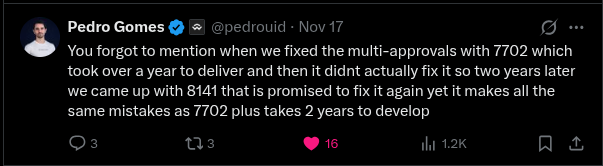
It is a harsh take, but it points at something true. Most of what stopped 7702 from delivering one-click swaps was not the cryptography. It was coordination: wallets had to ship delegation, apps had to adopt EIP-5792, every chain had to upgrade. A better transaction format does not remove any of those steps by itself. 8141 still needs wallets to build on it, apps to use it and chains to support it. And it does nothing for the bridge, because moving value between two chains is still two chains.
Meanwhile, at the wallet layer
The most practical reply came from my friend Glitch, who works on wallet infrastructure at Trust Wallet. He quoted Sebastian’s post with this:
Friendly reminder that swapping and bridging in Trust Wallet takes just one click.
With EIP-7702 enabled we batch the approval + swap
Without it, we sequence them using a per-chain nonce manager.
And approvals are limited to just the amount you swap.
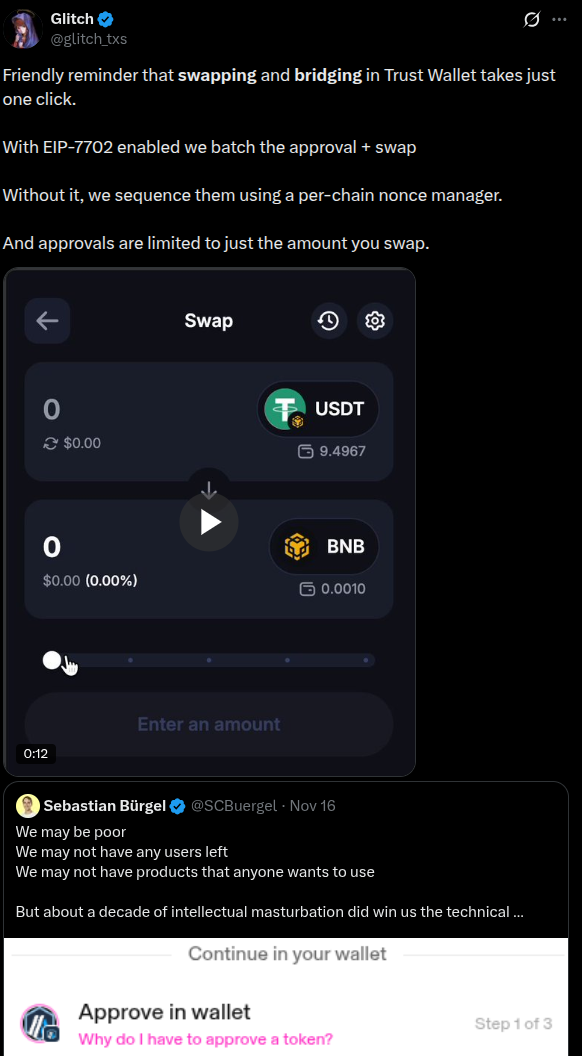
This is the part of the debate I find most useful. Two details stand out:
- The user never has to see the three steps. When 7702 is available, the wallet batches. When it is not, the wallet sends the transactions itself, in order, tracking the nonce on each chain so they land correctly. Either way, the user clicks once.
- Exact-amount approvals. Approving only what the swap needs is the principle of least privilege applied to tokens: give a contract exactly the permission it needs for the job and nothing more. It shrinks the damage if that contract is ever exploited, and it fixes the “approvals outlive the swap” problem that neither batching nor revoking a delegation solves. It costs nothing at the protocol level.
So, is the protocol the right place to fix this?
My view: both layers matter, but they solve different problems.
The protocol can make good UX possible and safe. 7702 made batching possible for normal accounts without a new address. 8141 aims to make batching truly atomic, sponsorship native and signatures replaceable, which matters a lot in the long run, especially for post-quantum security.
But the protocol cannot make good UX happen. That is the wallet’s job and the app’s job. Trust Wallet’s approach shows that much of the “three signatures” pain can be removed today, with the tools that already exist, by deciding that the user should never see the plumbing.
The parts no single-chain EIP can fix are the approval model itself and cross-chain movement. Those need work at the token-standard and interoperability layers, such as cross-chain intents, where the user states the outcome they want and someone else handles the route.
So, to answer Sebastian’s question, have we earned it? Not yet. 7702 made one click possible, 8141 promises to make it native, and the wallets that care about their users are not waiting for either.
References
- Sebastian Bürgel’s post: https://x.com/SCBuergel/status/2122413041971314705
- Glitch’s quote post: https://x.com/glitch_txs/status/2122665033498865738
- Pedro Gomes’s reply: https://x.com/pedrouid/status/2122575906451619915
- EIP-7702: Set Code for EOAs
- Eco, ERC-7702 Deep Dive 2026: EOA Becomes Smart Wallet (16 September 2026), used for the 7702 mechanics, wallet adoption and risks above
- EIP-8141: Frame Transaction · eip8141.io · Forkcast
- ERC-4337: Account Abstraction
- EIP-5792: Wallet Call API
- EIP-2612: Permit
- My earlier write-up: EIP-8141 deep dive